
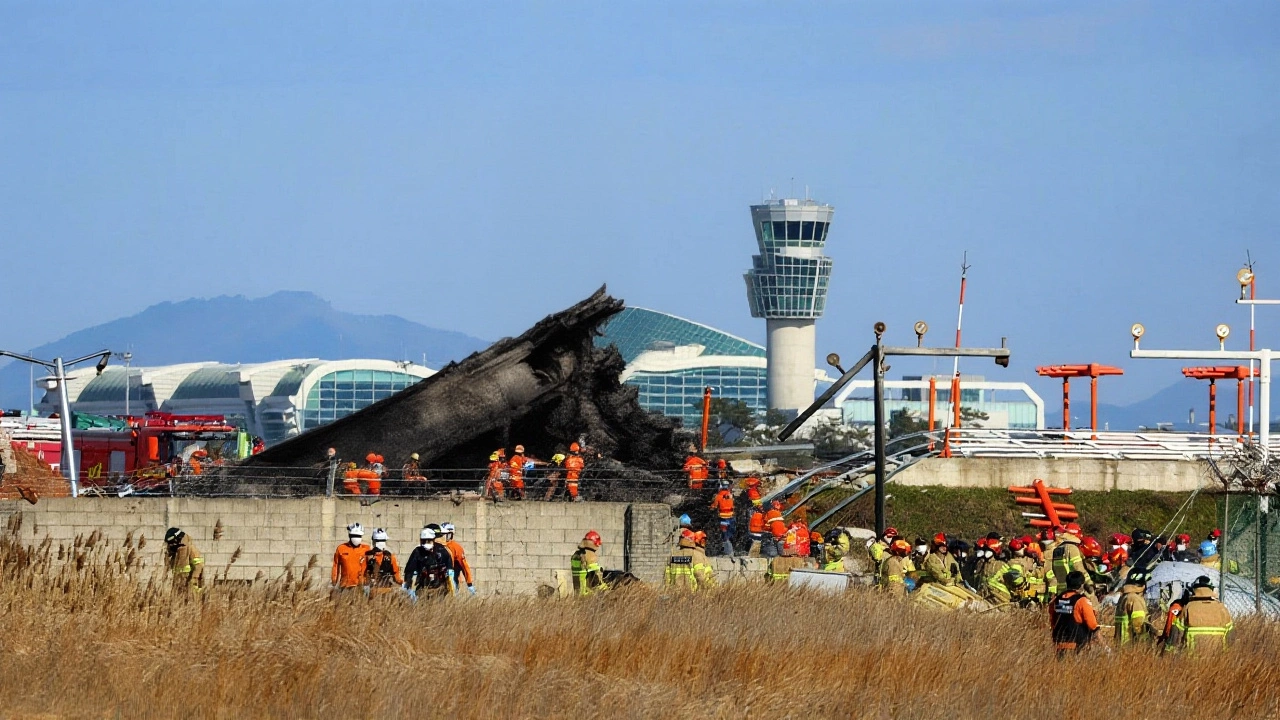
When Azerbaijan Airlines Flight 8243Aktau airport slammed into the ground on Dec. 25, 2024, missile fragments from a Russian air‑defence system had pierced the fuselage, sending 38 of the 67 people aboard to their deaths, the Emergency Situations Department said.
The Airbus‑type jet – the airline declined to name the model – had taken off from Heydar Aliyev International Airport in Baku at 09:10 local time, bound for Aktau on a routine CIS‑airspace route. By 10:28, the crew lost contact with controllers while attempting a go‑around after an aborted first approach.
Background and Flight Details
Azerbaijan Airlines, officially Azerbaijan Hava Yollary Open Joint Stock Company, operates approximately 25 domestic and regional services daily. The flight carried 62 passengers and five crew members, including two pilots, Vagif Aliyev, the airline’s Director of Operations, who later confirmed the missile‑fragment cause.
Kazakhstan’s Ministry of Transport, headed by Ratiyev Marat Kenzhalievich, had coordinated with Azerbaijani authorities for the scheduled arrival. The aircraft’s flight plan indicated a single‑runway approach using runway 06L, but radar showed a sudden deviation just seconds before impact.
Crash Sequence and Immediate Aftermath
At exactly 10:30 AZT, the right wing clipped the grass strip three kilometres from the runway. Video taken by a nearby observer shows the landing gear down, the wing shuddering, then the plane somersaulting before breaking into two sections. The forward fuselage ignited instantly, while the tail fell upside down about 300 m away, largely intact.
Witnesses reported a deafening roar and a plume of orange fire that rose for roughly two minutes. Emergency crews, already on standby at Aktau airport, arrived at 10:35 and began fighting the blaze. By 11:05 they had extinguished all flames, allowing them to focus on rescuing the trapped occupants.

Rescue Operations and Survivor Care
The Emergency Situations Department deployed 47 responders, 12 fire‑suppression trucks, and eight ambulances under a Code Red protocol. Within 20 minutes, they extracted 29 survivors, including a four‑year‑old girl and a seven‑year‑old boy who were miraculously pulled from the wreckage with only superficial injuries.
All survivors were taken to Aktau City Hospital. Doctors recorded 19 cases of closed craniocerebral injuries, 22 concussions, and 15 chest traumas. Eleven patients required mechanical ventilation in intensive care. The hospital chief, Dr. Alina Tursunova, noted that “the rear‑section seating saved most lives – 25 of the 29 survivors were seated behind row 20.”
Two flight attendants survived; they recounted that the pilots first ordered a water landing, then abruptly switched to a ground‑landing command as the aircraft lost control.
Investigations and Official Reactions
The Civil Aviation Administration of Azerbaijan opened a formal probe under Regulation No. 2024‑12‑8243 at 18:00 AZT. Investigators collected missile debris, flight‑data recorder excerpts, and cockpit voice recordings. Preliminary analysis, presented by Ratiyev Marat Kenzhalievich at a press briefing, indicated that fragments from a Russian S‑300 system had struck the aircraft during its final approach.
“Our forensic teams have identified metallic fragments consistent with Russian air‑defence ammunition,” Ratiyev said, adding that the exact origin of the missile would be clarified after joint investigations with Russian authorities.
Vagif Aliyev, speaking at the airline’s headquarters in Baku, expressed deep sorrow: “We mourn every family affected by this tragedy. Our thoughts are with the victims, and we will cooperate fully with the investigation to prevent such a disaster from happening again.”
Kazakhstan’s Transport Minister announced that all flights over the conflict‑adjacent airspace would be rerouted pending a safety review, and that compensation packages for victims’ families would be coordinated with Azerbaijan Airlines.

Implications for Regional Aviation Safety
This incident marks the deadliest crash in Azerbaijan Airlines’ history since Flight 217 in 2005 and the worst air disaster Kazakhstan has seen since the 2013 cargo‑plane fire near Almaty. Aviation safety experts, such as Dr. Sergei Ivanov of the International Air Transport Association, warn that “the proximity of active military air‑defence zones to commercial corridors poses a grave, often overlooked risk.”
In response, the International Civil Aviation Organization (ICAO) is expected to convene an emergency meeting to discuss new corridor restrictions and real‑time threat‑assessment systems for civilian aircraft operating near conflict zones.
Meanwhile, families of the 38 victims are awaiting the final investigative report, slated for release within 12 months. The wreckage, still visible from the air, is being loaded onto three Kamaz trucks for transport to the National Transportation Safety Board facility in Almaty, where further metallurgical testing will be performed.
Frequently Asked Questions
How did missile fragments reach the aircraft?
Preliminary debris analysis shows that fragments from a Russian S‑300 air‑defence missile broke apart during a routine test, scattering shrapnel over the flight path. One piece penetrated the wing, causing rapid loss of control during the final approach.
Which passengers were most likely to survive?
Survivors were predominantly seated behind row 20, in the aircraft’s rear compartment. Structural damage was concentrated in the forward fuselage, so passengers there faced the brunt of the impact and fire.
What steps are being taken to prevent similar incidents?
ICAO is likely to issue new guidelines limiting civilian flight paths over active military air‑defence zones. Additionally, airlines are reviewing onboard threat‑detection systems and may alter routing to stay clear of known missile‑test areas.
When will families receive compensation?
Kazakhstan’s Transport Ministry announced a compensation framework in coordination with Azerbaijan Airlines. Details will be finalized after the official investigation report, expected within the next year.
Is there a risk that the same missile could hit another plane?
Experts say the likelihood is low but not negligible. Ongoing monitoring of missile‑test zones and real‑time flight‑path adjustments are essential to mitigate the danger of stray fragments.
